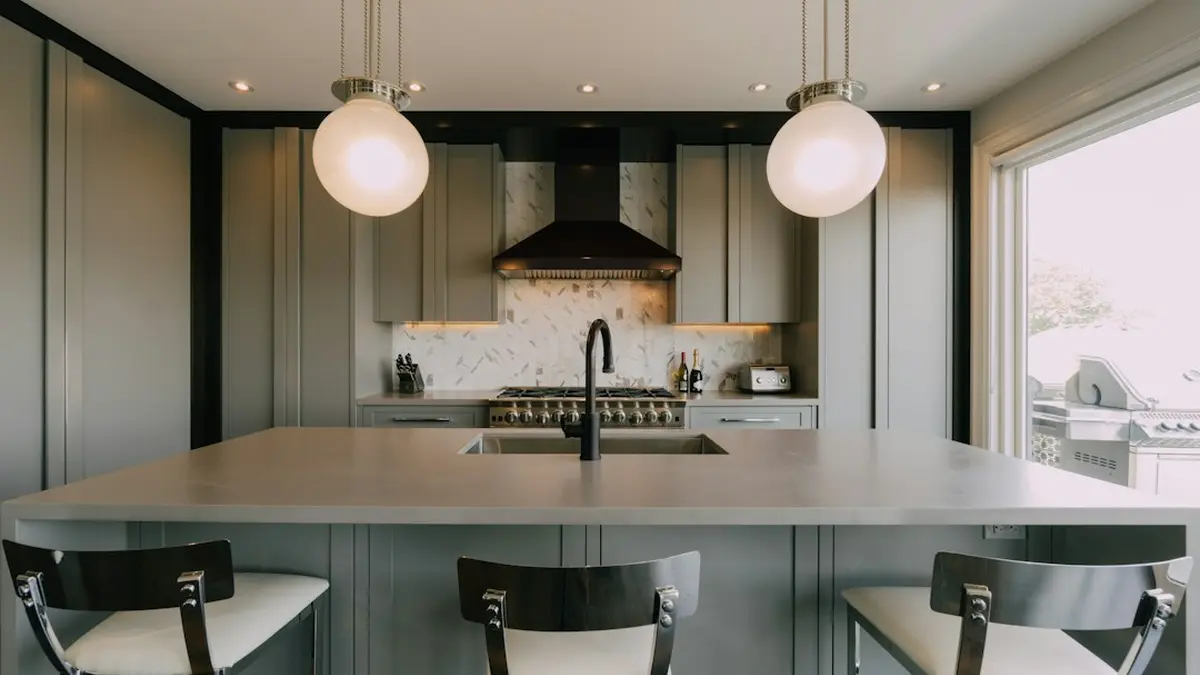
An island range hood usually costs $500 to $1,700 installed, unit and labor together. If no ductwork exists and the installer has to run a new, long path through the ceiling to the roof, plan on $2,000 to $4,000. The premium over a wall hood comes from where the hood hangs, not from the hood itself. A wall hood vents straight through the wall behind it. An island hood has nothing behind it, so the duct goes up through the ceiling and out through the attic or roof, and the hood hangs from joists that may need reinforcing.
You will run into this number when an island cooktop shows up in a kitchen plan and the hood line on the bid is two or three times what you expected. The rest of this page explains that gap, so you can tell whether a quote is padded or whether your ceiling is simply expensive to get through.
Why the ceiling changes the price
The extra cost comes from four separate pieces of work. Each one shows up on the bid in its own way.
The duct path. A wall hood's duct can be a short straight run. An island hood's duct has to rise through the ceiling, cross the attic and exit through the roof, usually with elbows along the way. Arspura, a hood seller, prices a straight 6-foot wall run at about $200 and a 15-foot ceiling run with three elbows at $600 or more for the ductwork alone. It puts ceiling or roof venting overall at $800 to $1,500. The same source warns that undersized ductwork can cut airflow by 30 to 50%, so a cheap duct is not a saving.
The mounting. The hood hangs from the ceiling, and a heavy chimney unit needs solid framing above it. Arspura's $1,000 to $2,000+ island figure includes ceiling support structure and drywall modifications. HomeGuide and Forbes Home both note that larger units often take two installers to lift and hold in place.
Power. The outlet or junction box has to be in the ceiling, not behind the backsplash. Electrical work adds $150 to $400, and more if a 240V circuit is needed.
Airflow. A common sizing rule is 100 CFM per 10 inches of cooktop width. On a wide island cooktop that rule can push you past 400 CFM, which is where makeup air comes in (see below). Many installers say an island hood needs more CFM than a wall hood over the same cooktop, because no wall helps contain the rising smoke and steam. Our sources do not put a residential figure on that difference. Treat it as a reason to ask your installer how they sized the hood, not as a number to budget.
Three price points, and what sits behind each
Reusing existing ductwork: $500 to $1,700. HomeAdvisor's 2026 guide and Angi put island hoods at $500 to $1,400 for materials and labor. HomeGuide puts them at $600 to $1,700, which breaks down to $400 to $1,200 for the unit and $200 to $500 for labor. HomeAdvisor says island hoods "often require more installation time, as they must vent through the roof."
A new long ceiling run: $2,000 to $4,000. Forbes Home gives this range for the island job with no duct to reuse. If that describes your kitchen, the duct path, not the hood, is what you are mostly paying for. Our page on adding a new duct path breaks that line down by distance.
A big hood over a gas cooktop: add $1,000 to $3,000. Under IRC Section M1503.6, a hood that can exhaust more than 400 CFM needs makeup air in a home that has a fuel-burning appliance that is neither direct-vent nor mechanically draft-vented. The makeup air has to come in at roughly the rate the hood pulls out, through a damper that opens automatically when the hood runs. HVACDatabase prices makeup-air systems at $1,000 to $3,000. Local codes vary, so ask your installer whether this rule applies in your home.
A hypothetical 48-inch gas island with no existing duct
Say you're installing a hood over a 48-inch gas cooktop on a new island. The 100-CFM-per-10-inches rule suggests about 480 CFM, which is over the 400 CFM threshold. Using the source ranges for each line:
| Island hood unit (HomeGuide) | $400 to $1,200 |
|---|---|
| Installation labor (HomeGuide) | $200 to $500 |
| Ceiling or roof venting (Arspura) | $800 to $1,500 |
| Electrical work (Arspura) | $150 to $400 |
| Permit (Arspura, HVACDatabase) | $50 to $250 |
| Subtotal | $1,600 to $3,850 |
| Makeup air, if code requires it (HVACDatabase) | $1,000 to $3,000 |
| Total | $2,600 to $6,850 |
These ranges come from different sources, so use them to check a bid, not to stand in for one. The subtotal lines up with the $2,000 to $4,000 Forbes Home gives for a new ceiling run. Makeup air is the line that can roughly double the job.
Downdraft is not the cheap way out
A downdraft vent pulls air down at the cooktop and so avoids the ceiling. It is often suggested for islands for that reason, but it costs more, not less.
| Island hood | Downdraft vent | |
|---|---|---|
| Installed cost, HomeGuide | $600 to $1,700 | $1,000 to $2,000 |
| Installed cost, HomeAdvisor | $500 to $1,400 | $1,500 to $3,000 |
| Where the duct goes | Up through ceiling and roof | Down, not through the ceiling |
| Who it suits | Anyone with attic or roof access | Kitchens where an overhead hood won't work or would block sightlines |
Don't confuse an island hood with Angi's and HomeAdvisor's $1,750 national average either. That average covers every type of hood and every level of job complexity. Fixr's $714 average assumes a ductless 42-inch hood. Neither one is an island figure.
Before you sign
When an island hood quote lands, check four things.
- Is the duct new or reused? That alone separates a $1,400 job from a $4,000 one.
- What CFM is the hood, and does it cross 400? If it does and you cook with gas, ask whether makeup air is in the price or will come as a change order later.
- Is ceiling framing included? Blocking and drywall patching should appear as line items, not be assumed.
- Who pulls the permit? A roof penetration typically needs one, at $50 to $250 depending on where you live.
The line items a quote should include are worth knowing before you compare bids. Get at least two quotes on the same scope, with the same duct route and CFM, so the numbers can actually be compared.
Comments
No comments yet. Be the first to comment!
Leave a Comment