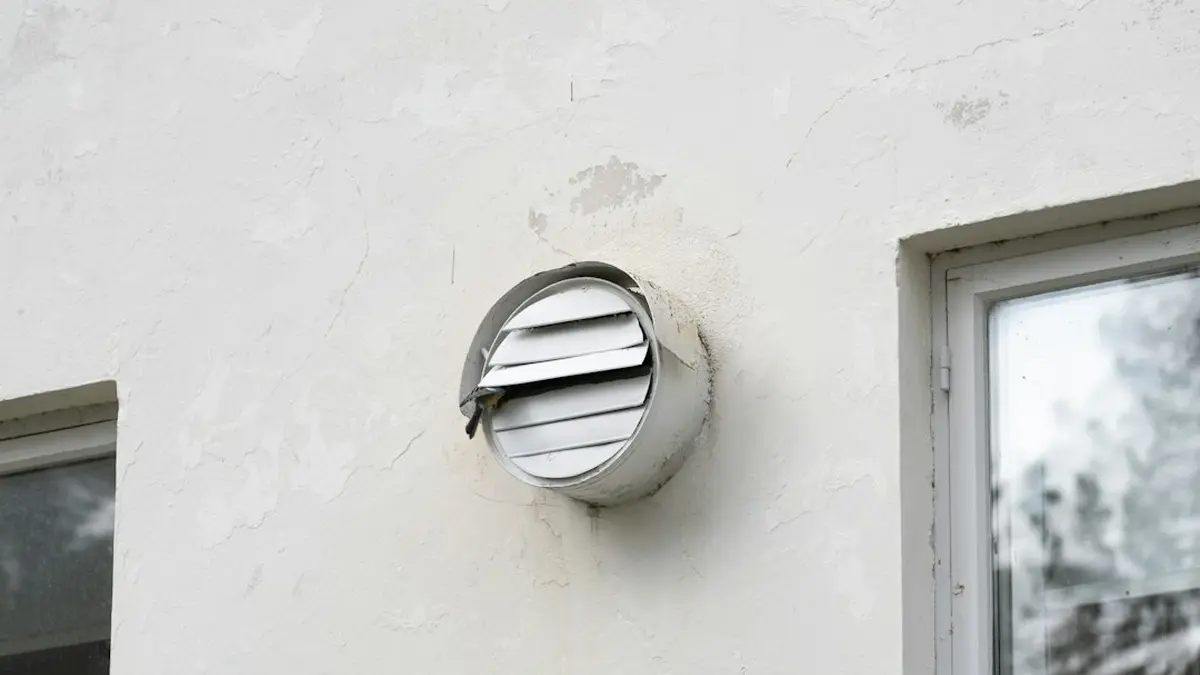
If your kitchen has never vented to the outside, the duct run is its own cost on top of the hood and the labor to hang it. The 2026 guides most often put it at roughly $300 to $600 for a short, simple run, and it climbs from there. HomeAdvisor put average ductwork at $500 for materials and labor in June 2026. Homewyse listed $501 to $602 per run in September 2026, and that price covers up to 15 feet of metal duct, the wall or roof cap, flashing and testing.
Four things push the number up: distance to an exterior wall, the number of turns, whether the duct has to cross joists or go through the roof, and whether it ends at a roof cap or a wall cap. The duct is the part of a range hood bid that varies most, so it is the line to understand before you compare prices.
What the code makes you buy
The price starts with the material, and in most places the code chooses it for you. IRC Section M1503 requires range hood ducts to be galvanized steel, stainless steel or copper. The duct must be smooth inside, airtight and fitted with a backdraft damper. It must also discharge outdoors. It cannot end in an attic, crawl space or soffit, and it cannot share a run with a bathroom fan or dryer vent.
Under the 2024 IRC, as summarized by Jaspector, the minimum size is 6-inch round. Flexible foil and plastic duct are prohibited outright. That rules out the cheap flexible duct priced at $1 to $3 per foot. Sheet metal duct runs $7 to $13 per foot for material alone, according to HomeGuide.
Installed, new duct costs $40 to $65 per linear foot according to both Angi and HomeGuide. Gerhard's Appliances quotes a much higher $100 to $400+ per foot. Read that figure as an all-in rate that already includes obstacles and termination, not as the price of the pipe. None of the sources price 6-inch and 8-inch duct separately, so no one can tell you from this data what the jump in diameter costs. Ask your installer to break it out.
Three code details add labor you might not expect:
- Elbows count against the run. Each 90-degree elbow is subtracted from the maximum allowed equivalent length. A twisting route can force a larger duct or a stronger hood.
- Supports. Round duct needs a hanger at least every 6 feet.
- The cap is regulated. It must be grease-resistant, close under gravity and have no screen.
The cap is real hardware, but the sources fold it into the run price rather than listing it on its own.
Finally, if you have a gas range or other fuel-burning appliance and the hood exceeds 400 cfm, the code requires makeup air. That means a second duct and a second hole in the house.
Three runs, three price bands
Range on an exterior wall. This is the cheapest case. HomeGuide puts side-wall venting at $200 to $650. Its appliance guide prices a kitchen exhaust fan with a new wall vent cut at $260 to $850 total. If the duct goes straight back through the wall, you are near the bottom of every range.
Up through the roof. HomeGuide prices roof venting at $400 to $900 on a one-story home and $1,000 to $2,000 on a two-story, where the duct has to pass through a floor as well. Angi puts a roof-vented installation, hood included, at $1,800 to $3,500. It cites flashing, steep pitches, attic crossings and long runs as the drivers.
An island. Fixr lists an island hood with new ductwork at about $900 in labor, its most expensive scenario. The duct has to rise into the ceiling and cross joists to reach an outside wall or the roof. This is where some homeowners stop and price a ductless unit instead. HomeAdvisor puts ductless exhaust systems at $100 to $300.
Not HVAC duct, and not a ductless hood
| Range hood duct | What it gets confused with | |
|---|---|---|
| HVAC ductwork | Rigid metal only, 6-inch minimum, ends outdoors at a damper cap | Homewyse's $15.89 to $19.04 per foot is based on 8-inch flexible insulated duct, which a range hood cannot use |
| Ductless hood | Removes smoke, moisture and combustion gases from the house | Filters and recirculates; allowed under the IRC only where other ventilation is present |
The ductless option saves the most money, but it is the wrong choice if you cook on gas. The EPA notes that gas cooking gives off carbon monoxide and nitrogen dioxide. Its advice is plain: "Use a vented range hood over your stove every time you cook."
Before you ask for bids
Measure the shortest route from the hood to outside, and decide wall or roof before anyone quotes. The difference between those two can be larger than the price of the hood.
Then check each bid on these points:
- Footage and elbows. The bid should state the duct's length and the number of elbows.
- Material. The duct should be rigid metal with no flexible section.
- Cap. It should be a grease-resistant damper cap.
- Makeup air. Ask whether it is included if your hood is over 400 cfm and you cook on gas.
- Permit. Ask who pulls it. Mechanical permits run $100 to $230 in most cities, per Angi and HomeGuide.
- Overhead. If a general contractor manages the job, Homewyse says to add 13% to 22% overhead.
The sources give national figures only. Homewyse adjusts by zip code, and HomeAdvisor's $50 to $100 hourly labor range reflects regional differences. Local quotes are the only way to see where your region falls. Once you have them, compare the line items against a written quote so the duct is not hiding inside a single "installation" number.
Comments
No comments yet. Be the first to comment!
Leave a Comment