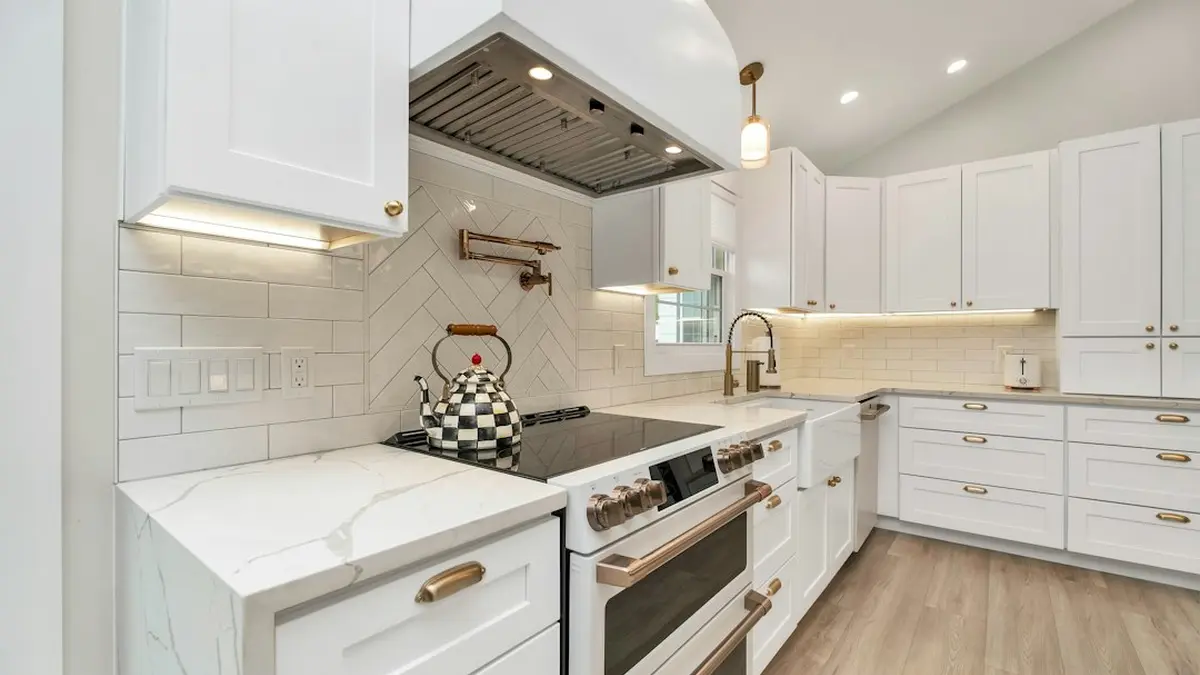
A professionally installed range hood cost $650 to $2,500 in 2026, with a national average of $1,750, according to HomeAdvisor's range hood cost guide (updated June 19, 2026). The same figures appear in Angi's 2026 data. If you are swapping an old hood for a new one on a duct and outlet that already work, expect the low end of that range or below it. If the kitchen has never had a vented hood, or you are moving the range to an island, plan for the upper half. This page is for the homeowner pricing a hood as a standalone job or as one line in a kitchen remodel, who wants a planning number and a way to check the contractor's bid against it.
The mistake most people make is pricing the hood and treating installation as a fixed extra. On most jobs the hood is not what sets the bill. What sets it is whether a duct already runs to the outside. HomeAdvisor puts a replacement install at $300 to $850, and HomeGuide's 2026 figures put a job that needs new ductwork or a new circuit at $2,000 or more. The same hood can land in either bracket depending on what is behind the wall.
How the price is built
Every range hood bid is the same handful of lines added together: the unit, the labor to hang and connect it, venting work if there is no usable duct, electrical work if there is no usable outlet or circuit, patching, and a permit where your town requires one. A job that only needs the first two is cheap. A job that needs all six is not.
The national averages disagree, and the reason is which jobs each source counts. HomeAdvisor and Angi report a $1,750 average (2026). Fixr reports $714, with most jobs between $500 and $1,000 and a full spread of $427 to $1,539 (updated January 31, 2025). HomeGuide reports a $900 average, with jobs running $400 to $1,800 including the unit and labor (2026), and says its data includes a lot of simple replacement jobs. Bob Vila put the average at $750, with most homeowners paying $400 to $1,500 (updated November 27, 2023). Read the lower figures as "a swap" and the HomeAdvisor and Angi figure as "a mix that includes a lot of new venting."
There are three ways the job gets done, and you are choosing one of them whether you realize it or not.
| Like-for-like swap | New ducted install | Ductless install | |
|---|---|---|---|
| Installed cost (HomeGuide, 2026) | $200 to $850+ (ducted, existing ductwork) | $1,200 to $2,500+ (new ductwork) | $200 to $400 |
| Scenario cost (Arspura, 2026) | $150 to $300 on existing ductwork | $500 to $1,000 through a wall; $800 to $1,500 through ceiling or roof | Not broken out separately |
| Labor only (Fixr, Jan 2025) | About $300 | About $500; island with new duct up to $900 | About $300 for a new hood with wiring |
| Time on site (Arspura, 2026; Bob Vila, 2023) | 1 to 2 hours | 3 to 5 hours through a wall; up to a full day through ceiling or roof | 1 to 2 hours |
| Permit trigger (HVACDatabase, undated) | Usually none unless electrical is modified | Yes, for the exterior wall or roof penetration: $50 to $250 | Only if new electrical work is done |
| Removes heat and moisture from the house (HVACDatabase, undated) | Yes | Yes | No; filters and recirculates |
The swap is right if the existing duct is the right size, exits the house, and sits where the new hood will go. It is wrong if you are upgrading to a much more powerful hood, because an old duct sized for a small fan can choke a big one.
The new ducted install is right for gas ranges and heavy cooking; HVACDatabase recommends ducted venting for both and prices the extra at $200 to $600. It is wrong if the only duct route is long and full of turns, because Arspura (2026) reports that poorly sized ducts, unsealed joints and unnecessary bends can cut a hood's airflow by 30 to 50 percent. At that point you are paying for power you do not get.
Ductless is right when there is no practical route outside, such as an interior wall in a condo, and the cooking is light. It is wrong for anyone who sears, fries or cooks on gas most nights, because it does not remove heat or moisture.
Pricing and hiring, in order
Work through these in sequence. Each step either narrows the price or tells you a contractor needs to see the kitchen before quoting.
-
Cooktop width in inches
Sets the minimum airflow the hood needs.
-
Fuel type (gas or electric) and whether it is a professional-style range
Pro gas ranges need far more airflow than a standard range.
-
Where the old hood or microwave vents, if anywhere
Look for a duct collar on top of the unit and a wall or roof cap outside.
-
Whether there is an outlet or hardwired connection above the range
Decides whether an electrician is on the bid.
-
Photos of the cabinet above the range and the exterior wall or roof behind it
Lets a contractor give a tighter estimate before a site visit.
-
Your city or county permit office phone number or website
You will need it at step 5.
1. Set the airflow target. HVACDatabase's rule of thumb is 100 CFM (cubic feet per minute) for every 10 inches of cooktop width, so a 30-inch range needs at least 300 CFM. Professional gas ranges need 600 to 1,200 CFM. It worked when you have one number, and you know whether it is above or below 400. Cost: nothing, 5 minutes.
2. Find out which column you are in. Pull the filters off the old hood and look up. A round or rectangular duct leaving through the top or back that ends at a cap outside means you are probably a swap. Filters only, with the air blowing back into the room, means the old hood was ductless and a ducted upgrade is a new install. No hood at all, or a microwave, means a new install; Arspura (2026) prices converting a microwave spot to a range hood at $400 to $1,200. It worked when you can say "existing duct," "new duct through the wall," "new duct through the ceiling or roof" or "ductless." Cost: nothing, 15 minutes.
3. Check the makeup air trigger. If your number from step 1 is above 400 CFM, HVACDatabase says many jurisdictions require a makeup air system in a modern, tightly sealed home, at $1,000 to $3,000. That can cost more than everything else on the job combined. It worked when you know whether your target crosses 400, and you have either dropped to a hood at or under 400 that still meets your cooktop's minimum, or budgeted for makeup air. Cost: nothing to decide; $1,000 to $3,000 if required.
4. Pick the unit and write down its price and date. The research behind this page did not capture current retail listings for specific hood models, so there are no model prices here. Use the type ranges below as a sanity check, and record the listed price, CFM and sone rating from the maker or retailer on the day you look, because listed prices on imported metal goods moved several times in 2026 (see the tariff note further down). Fixr's January 2025 material costs: under-cabinet or wall-mount $200 to $500, island $300 to $900, cabinet insert $400 to $1,000, downdraft $1,000 to $2,500. By venting style (HomeAdvisor, 2026): ductless $100 to $300, ducted $100 to $1,000, convertible $200 to $1,200. By finish (Bob Vila, 2023): traditional black, white or bisque $100 to $1,000, stainless $300 to $1,500, copper $250 to $1,250, with designer models reaching $8,000. It worked when the unit's CFM matches step 1 and step 3, and you have its price with a date beside it. Cost: the unit.
5. Call the permit office. Ask two questions: is a permit needed to cut a new vent through an exterior wall or roof, and is one needed for new electrical work? HVACDatabase and Arspura (2026) both put permits at $50 to $250; Bob Vila (2023) put them at $100 to $230. Ask who pulls it. The contractor normally does, and it should show on the bid. It worked when you know yes or no, the fee, and whether makeup air is required above 400 CFM in your jurisdiction. Cost: $50 to $250 if required, plus an inspection visit.
6. Get at least three bids, itemized. A bid you can compare lists each of the following as its own line, or says plainly that it is not needed:
- The hood, with model number, or "customer-supplied"
- Removal and disposal of the old hood ($25 to $50, Bob Vila, 2023)
- Installation labor, as hours and rate or a flat fee (HomeAdvisor, 2026: $85 an hour on average, $50 to $100, 1 to 4 hours)
- Duct: diameter, length, number of elbows, material, and where it exits
- Wall or roof cap with a backdraft damper
- Electrical: new outlet, hardwire, or dedicated circuit (Arspura, 2026: $150 to $400 for a dedicated 120V circuit, more for 240V)
- Cabinet modification, if a cabinet above the range has to be cut or removed
- Drywall patch and paint (Arspura, 2026: $100 to $300)
- Permit and inspection
- Makeup air, if your jurisdiction requires it
It worked when all three bids have the same lines, so the differences show up as numbers rather than as missing items. Cost: a few hours of your time over one to two weeks.
7. Compare the duct line first. It is where bids diverge most. Arspura (2026) prices a straight 6-foot duct run at about $200, and a 15-foot run with three 90-degree elbows at $600 or more. If one contractor routes the duct straight through the wall behind the range and another routes it up through the ceiling and across to the roof, the cheaper route is usually also the one that keeps more of the hood's rated airflow. Ask each bidder why they chose their route. It worked when you can explain the price gap between the highest and lowest bid in a sentence. Cost: nothing.
8. Check the finished job. Before paying the final amount, confirm the duct joints are sealed, the outside cap has a damper that closes when the fan is off, the inspection passed if a permit was pulled, and the wall or ceiling is patched as the bid said. It worked when the damper flaps open at high speed and shuts when you turn the hood off, and you have the inspection sign-off in hand. Cost: nothing.
The figures on this page are planning numbers, not a quote. Your price depends on your house, your duct route and your local labor market, and only a contractor who has seen the kitchen can give you that number.
Where installs go wrong
A strong hood on a weak duct. You buy a hood rated well above your old one and bolt it to the old duct. You notice it when the hood is loud on high but smoke still rolls past it into the room. Arspura (2026) reports airflow losses of 30 to 50 percent from undersized ducts, unsealed joints and extra bends. Before buying, ask whether the existing duct matches the new hood's outlet size. If it does not, the job is not a swap and should be priced as partial new ductwork.
The makeup air surprise. A bid comes in, then the inspector or the contractor adds $1,000 to $3,000 for makeup air (HVACDatabase) because the hood is over 400 CFM. You recognize the risk if your chosen hood is rated above 400 and nobody has mentioned makeup air. Settle it with the permit office at step 5, before you sign.
No permit on a new penetration. A low bid often gets low by leaving the permit out. HVACDatabase describes permits as a near-universal cost when a job cuts through an exterior wall or roof line, and says DIY venting projects often stall when homeowners find they need sign-off. If a bid cuts a new hole in the house and shows no permit line, ask why in writing.
The duct that goes the long way. Two bids for the same hood can differ by hundreds of dollars on routing alone (Arspura, 2026: $200 for 6 straight feet versus $600 or more for 15 feet with three elbows). A long route costs more to build and moves less air afterward. Ask for the duct length and elbow count on every bid.
Old-house extras. HVACDatabase notes older homes cost more because of tight spaces and structural obstacles. If your house has plaster walls, joists running the wrong way for the duct, or a cabinet that has to be rebuilt around the hood, expect a site visit before a firm price and treat any phone quote as a floor.
Region, climate and this year's tariffs
Region. None of the large cost sources for this page publish a breakdown by Northeast, South, Midwest and West; HomeAdvisor's June 2026 guide says so directly by giving national figures only. The one regional figure available is Arspura's (2026): installation prices run 15 to 25 percent higher in major metros such as New York, San Francisco and Boston. Take that as a direction rather than a precise markup, since it comes from a single hood retailer. If you live in or near one of those cities, add 15 to 25 percent to the national ranges above as a planning cushion. Outside the big metros, the national ranges are the best starting point the published data supports.
Climate. HVACDatabase lists three climate conditions that change the materials line, and each maps to a part of the country. In cold climates, which covers much of the Northeast and Midwest, it calls for insulated duct and a backdraft damper because of ice-dam risk. In hot, humid climates, common across the South, it calls for insulated ductwork. On the coast, in any region, it calls for stainless steel duct because standard galvanized duct corrodes. Each is a reason for a line on your bid to cost more than the national average, and each is worth paying for.
400 CFM. This is the threshold that changes the job most. Above it, many jurisdictions require makeup air in a tightly sealed home (HVACDatabase). A 30-inch electric cooktop needs about 300 CFM by the 100-per-10-inches rule, so it can often stay under the line. A professional gas range at 600 to 1,200 CFM cannot.
Tariffs on imported metal. A hood is mostly steel, often with an aluminum blower wheel and a copper-wound motor, and the duties on all three moved during 2026. On April 6, 2026, Section 232 steel duties began applying to the full customs value of covered imported products rather than only their metal content, according to the Federal Register notice the Bureau of Industry and Security published August 6, 2026. Then, effective June 8, 2026, "certain residential HVAC systems and components" moved to a temporarily reduced 15 percent duty that runs through December 31, 2027, according to GHY International's advisory (updated August 31, 2026). None of the sources confirm whether range hoods specifically fall under that HVAC category. The August 2026 notice proposed adding 14 more derivative articles to the duty list, and range hoods were not named among them.
What that means for you: a hood price you wrote down in the spring may not match the listing today, in either direction, and most of the published cost guides above were compiled before or during these changes. The one refreshed since, Angi in October 2026, still puts the national average at $1,750. Record the listed price on the day you buy and hold the contractor's quote to a date.
The numbers, and what they buy you
Installed ranges by hood type, as HomeAdvisor published them in 2026: under-cabinet $700 to $1,000, wall-mounted $700 to $1,000, island $500 to $1,400, cabinet insert $1,000 to $1,500, downdraft $1,500 to $3,000. Bob Vila's 2023 figures match these almost exactly. Island hoods show a lower floor than under-cabinet hoods in those ranges, but their ceiling is higher, and Fixr (January 2025) puts island labor at about $300 on existing ductwork and up to $900 when new ductwork is needed. An island job with no duct overhead belongs at the top of its range.
Add-on lines, when your job needs them:
- New ductwork: about $500 including materials and labor (HomeAdvisor and Angi, 2026; HomeGuide, 2026). HVACDatabase prices duct and vent cap at $200 to $600.
- Electrical: $0 to $400 depending on whether an outlet exists (HVACDatabase); $150 to $400 for a dedicated 120V circuit (Arspura, 2026).
- Permit and inspection: $50 to $250 (HVACDatabase; Arspura, 2026).
- Drywall patch and paint: $100 to $300 (Arspura, 2026).
- Old hood removal: $25 to $50 (Bob Vila, 2023).
What the money buys is a kitchen that clears smoke, heat and moisture, and that depends on the duct as much as on the hood. None of the sources for this page measure a resale payback for a range hood on its own. If the hood is one line in a larger kitchen project you plan to borrow for, it is worth comparing a HELOC and a cash-out refinance before you commit to the whole budget.
Comments
No comments yet. Be the first to comment!
Leave a Comment